

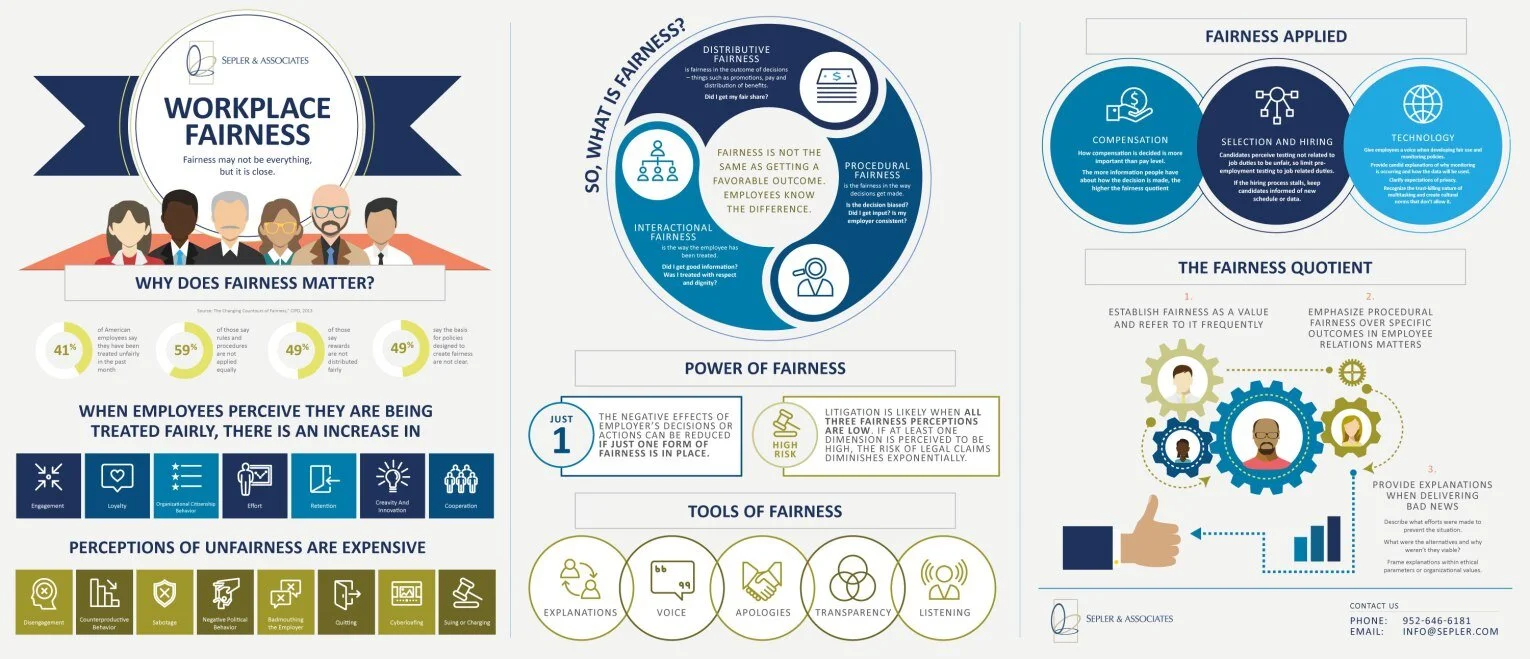
I had the honor of speaking at HR West today. It is one of the best HR conferences in North America, filled with energetic keynotes, informative breakouts and entertaining exhibitors. Today I delivered “The Fairness Quotient and Why it Matters,” an evolving talk about the power of fairness to create resilience and loyalty in employees. Today was special for me because I got to roll out my newly commissioned infographic:
If you would like a high quality hard copy of this infographic (suitable for hanging!) sent to you by snail mail, please drop me a line at [email protected]. If you’d like to hear more about workplace fairness, just let me know.
What I’m excited about is the concept that organizations don’t have to be perfect. The evidence shows that if you are strong on only one dimension of fairness– distributive, procedural or interactional — that you significantly reduce the likelihood of employee claims and charges. For years, I have been telling clients that outcomes are less important than process, that explanations are more important than outcomes, and that voice takes precedence over facts when trying to establish facts. What this infographic puts together is all of the positive things that can be mined by following that simple set of principles.
When we deliver difficult news– an unexpected business change, reductions in force, even telling someone they did not get the job or promotion — we have a choice about how to manage that. Explanations, hearing someone out, honesty and yes, even apologies (well-worded ones) can turn a potentially disengaged employee into a newly appreciative on. When we train supervisors to focus on a fair process, we gain the trust of employees in good times and bad, and when our leaders define fairness as a value, we create cultures that signal to employees every day that they matter. This, in turn, lights the switch on positive metrics such as engagement and retention, and it increases the likelihood that when people have problems they will come to us sooner, giving us the time and opportunity to help them resolve the problems and get back to work. This, my friends, is important and simple stuff.
